Exploration. Investigation. Possibility.
Explore beyond what we think we know.
What if there’s more to the picture than we think?

When did we decide the world was black and white?
Right or wrong? True or false? Good or bad? This or that?
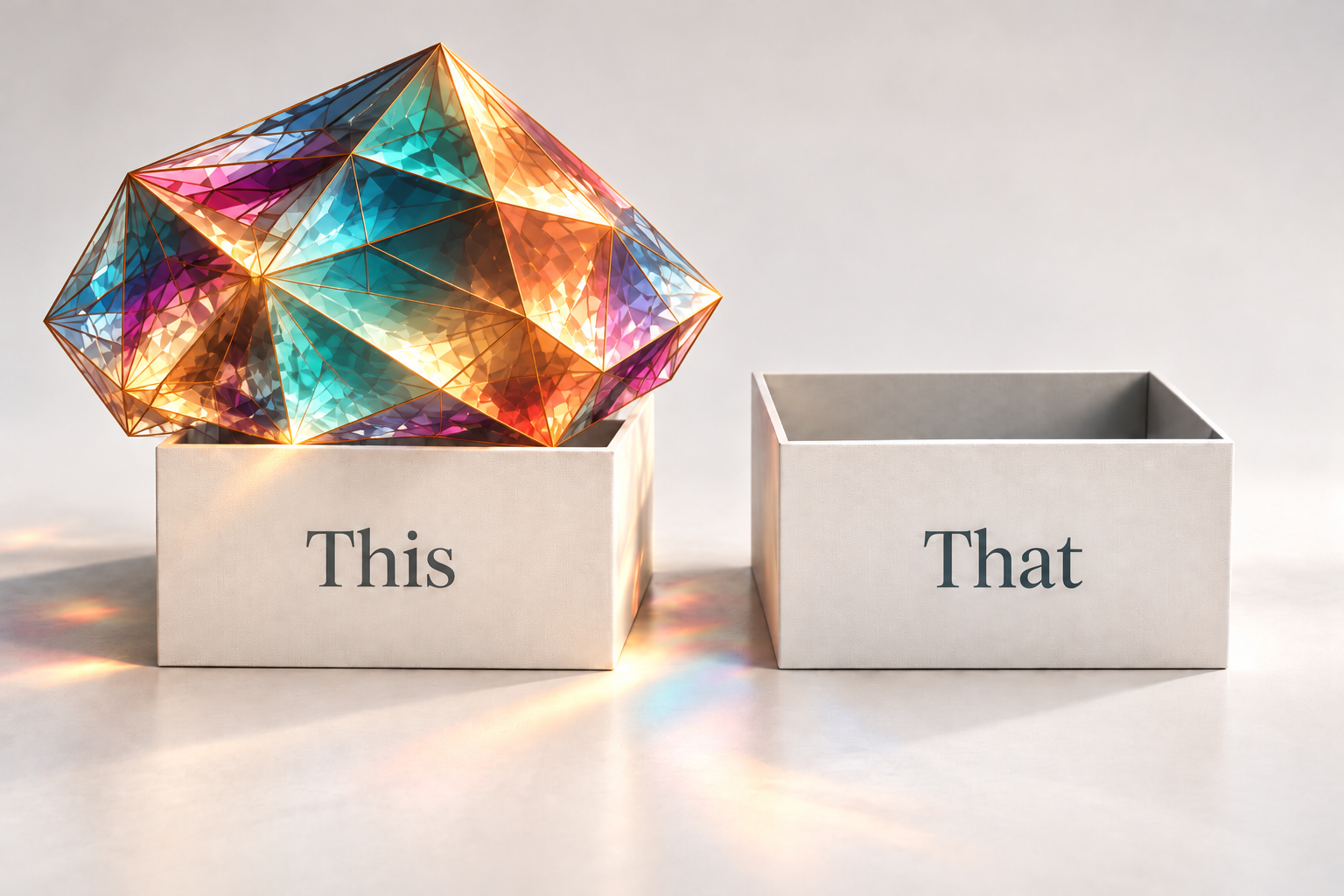
We often divide the world into neat little categories, as though everything must fit on one side or the other.
But our experiences, beliefs, and expectations influence how we interpret what we see. Sometimes, without even realizing it, we fill in what we don’t know with assumptions.
What happens when we mistake our interpretation for the whole picture?
What if the truth is more prismatic?
Maybe understanding begins when we stop assuming we’ve already seen the whole picture.
I’m learning that I have more questions than answers. But I’ve found real value in slowing down, remaining curious, and considering what I might be missing.
It helps me stay open to the possibility that someone else may experience the very same moment differently.
So, I invite you to explore with me.
Let’s question assumptions, explore different perspectives, and discover what possibilities we might uncover together.
Read moreWhat is a prismatic perspective?
Learning to see more of the whole picture.
A prismatic perspective is a way of exploring something through more than one perspective. We look at what different people see, what shaped their understanding, and what we might learn by bringing those views together.
Our experiences, beliefs, assumptions, expectations, needs, and the information we have all shape how we see the world. Someone else may have a piece of the picture we haven’t seen.
We don’t have to agree with a perspective to learn something from it. We can treat it as information: something to understand, question, and explore.
Why perspectives matter
What changes when we change our perspective?
Think about a pyramid. Look at it from above, from the side, from a corner, or from within. You’re looking at the same object, but you don’t have access to the same view.
From above
The base is square. The point is in the center.
From the side
One triangular face fills the view.
From a corner
Two faces meet along an edge.
From within
Looking up, the inside faces meet at the point.
What we see. What we assume. What we might be missing. From one or two sides, we may feel sure we know the rest of this structure. But what if the unseen side is open, or shaped differently from what we expected? Our prediction may be reasonable, yet it is still an inference—not something we’ve observed. We make much larger assumptions from far less: a photograph, a ten-second video, or a fragment of someone’s story. Another perspective can reveal something we didn’t know we were missing.
The same idea helps us explore people’s perspectives. What have they experienced? What data do they have? What do they need? What might we be missing from where we stand?
When perspectives contradict each other, or create friction, that gives us something to explore further. It doesn’t mean we have to choose a side before we understand the question.
The mindset
Curiosity over judgment.
We can listen without immediately agreeing or disagreeing. We can question our own assumptions. We can change our minds when we learn something that changes the picture.
Understanding a perspective doesn’t automatically make every claim within it true. It gives us a place to begin asking better questions.
Explore the prismatic perspective →The blog
Questions worth exploring.
Thoughts about the world we share, the ways we understand it, and what could be possible when we look closer.
Read the blogEmail updates
Get new posts in your inbox.
Get new posts from The Prismatic Perspective by email. You can unsubscribe at any time.